
The Design – Analysis Fluid Flow Simulation on Twin Screw Compressor | Ansys Fluent
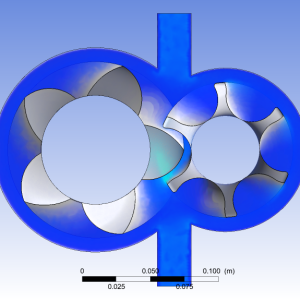
This simulation is about an Analysis Fluid Flow Simulation on Twin Screw Compressor using ANSYS Fluent software. We perform this CFD project and investigate it by CFD analysis.
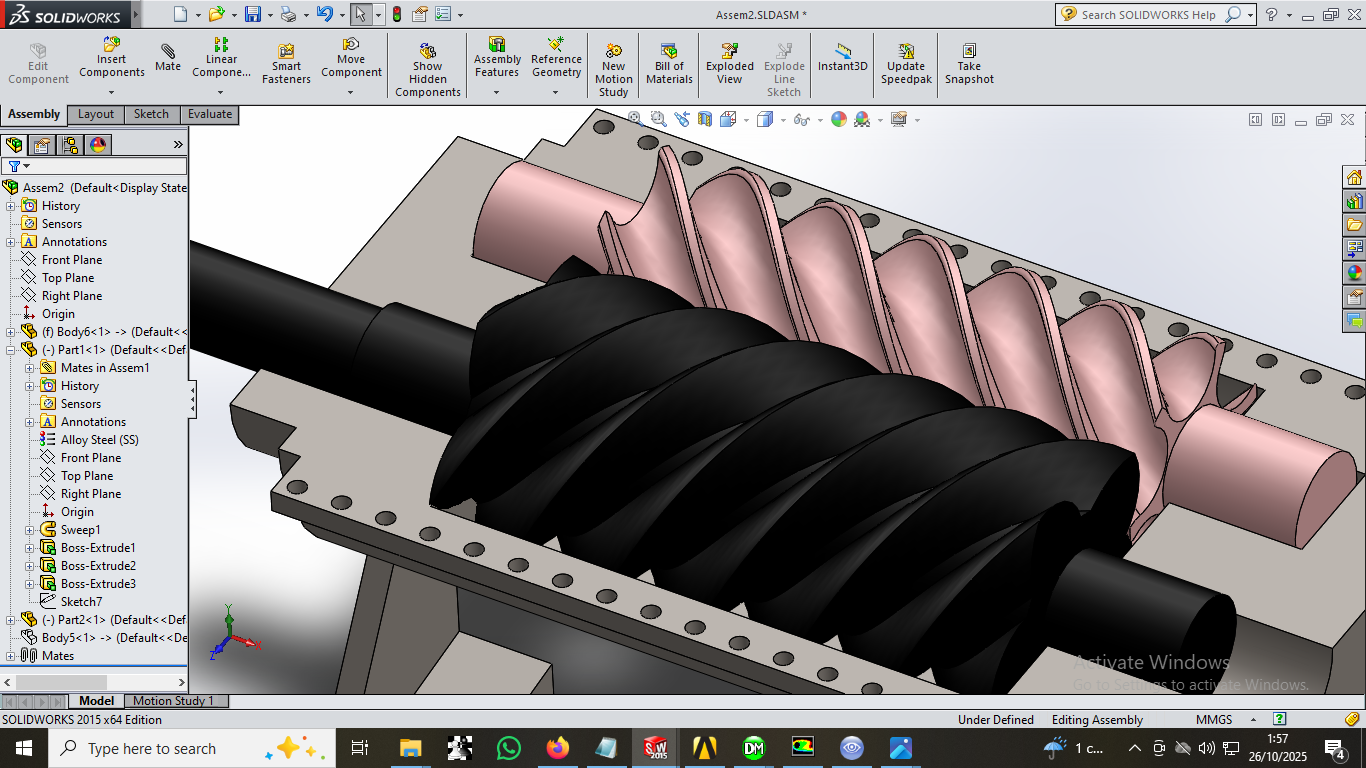
A twin-screw compressor is a positive displacement rotary machine with two inter-meshing helical rotors that draw in and compress a fluid, like air, as it moves through the device. The rotors are contained within a casing, and as they turn, the space between them and the casing shrinks, trapping and compressing the fluid until it is discharged. These compressors are known for their efficiency, reliability, and versatility in various industrial applications, and can be oil-injected or oil-free.
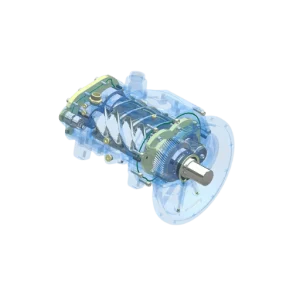
Picture 1. Twin-Screw Compressors
How it works
- Suction: Gas is pulled into the space between the rotors through an inlet port.
- Compression: As the rotors turn, the spaces between the helical lobes become progressively smaller, which compresses the trapped gas.
- Discharge: The compressed gas is expelled from the end of the rotors through an outlet port.
Key components
- Rotors: Two helical rotors, a male and a female, that intermesh to perform the compression. The female rotor typically has more lobes than the male rotor.
- Casing: Encloses the rotors and the entire compression process.
- Timing gears: Synchronize the rotation of the rotors to keep them from touching, ensuring proper operation.
- Lubrication system: For oil-injected versions, oil is used for cooling, lubrication, and sealing the rotors.
Types
- Oil-injected: Oil is injected into the compression chamber to help with cooling, sealing, and lubrication.
- Oil-free: No oil is injected into the compression chamber, making the discharged air suitable for applications where oil contamination is a concern.
Advantages
- Efficiency: They are known for high energy efficiency and a steady, continuous output of compressed air.
- Reliability: They have a stable and reliable performance, with many models built to handle high pressures and varying load conditions.
- Versatility: They can be used for various gases and in different industrial settings, including those with high temperature, high humidity, or corrosive gases.
- Compact size: Their compact structure saves space in industrial applications.
In this analysis, it has been made to simulate and analysis of Fluid Flow Simulation on Twin Screw Compressor using ANSYS Fluent software.
Geometry & Grid
The geometry required for flow analysis in a Twin Screw Compressor body is produced by ANSYS Fluent software. The generated grid is also produced by the same software for this geometry, which is entirely of an unstructured type. The total number of volume properties for geometry is 1,6043e+007 mm³.
Model
For analysis of the mixture process, a k-epsilon (2 eqn) viscous model is used to simulate fluid flow. Standard has been used for the K-Epsilon model. Standard Wall Functions are used for Near-Wall Treatment.
Boundary Condition
The flow input for this analysis is defined as the VELOCITY INLET for input velocity magnitude is 2 m/s. The walls of the Twin Screw Compressor are defined as Stationary Wall for Wall Motion. The output flow type is PRESSURE OUTLET, and the gauge pressure is equal to 0.
Discretization of Equations
According to the type of flow, the Coupled algorithm is used to discretize the Pressure-Velocity Coupling of the solution method. The turbulent kinetic energy and the turbulent dissipation rate have been discretized in the First Order Upwind.
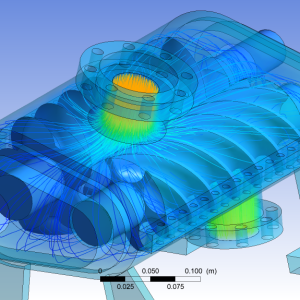
The results are presented as velocity contours as well as volume rendering.
The Design Services
We also accept all CFD projects using ANSYS Fluent and ANSYS CFX. Our workshop has gathered experts in different engineering fields so as to ensure the quality of CFD simulations. One of our objectives is to boost the use of powerful computational fluid dynamics methods and also teach the engineers and those who seek professional knowledge in CFD.
ِDoing CFD projects will be faster and easier with our services. Call us for training in CFD applications and CFD packages. Our professional CFD engineers offer you professional consultation and technical supports for your academic CFD projects and industrial CFD projects. We offer you CFD learning, CFD project by ANSYS Fluent and ANSYS CFX, CFD consulting by ANSYS Fluent and ANSYS CFX, CFD service by ANSYS Fluent and ANSYS CFX, ANSYS Fluent and ANSYS CFX project, ANSYS Fluent and ANSYS CFX thesis, ANSYS Fluent and ANSYS CFX simulation, ANSYS Fluent and ANSYS CFX paper regeneration, ANSYS Fluent and ANSYS CFX academic project, ANSYS Fluent and ANSYS CFX industrial project, ANSYS Fluent, and ANSYS CFX research project, and low CFD Price. Moreover, we have years of experience in coordinating CFD projects. Therefore, we are ready to perform your CFD simulations in different engineering fields.

Reviews
There are no reviews yet.